


Materials Used in Prefabricated Houses
A prefabricated house is a type of building whose components, in whole or in part, are manufactured in a factory and then transported to the installation site and assembled. In fact, the components of this type of house are built in advance according to a standard design and then appear in the form of a regular house.
The choice of materials for a prefabricated house is one of the most important factors that affect the quality, durability, beauty, speed of construction, and final price of the house. In this blog, we are going to discuss the materials used in prefabricated houses, please stay with us until the end of this article.
Features of prefabricated houses
These types of houses are more affordable than regular houses in terms of price and also have lower construction costs. Today, designers and architects offer customers a variety of prefabricated models, each of which can be extraordinary and practical in its own style.
Prefabricated houses are also made of a number of special and special materials. The same materials used to build ordinary houses can be used in the construction of prefabricated houses.
In fact, the interior materials of prefabricated houses are lightweight and durable so that the prefabricated parts can be easily installed in the desired location. Of course, these parts are easily assembled and very easy to transport. It is better to know that prefabricated houses have a long life and can be used for years.
Note that the interior materials of prefabricated houses can be soundproofed, thermally, moisture-proofed, and refrigerated so that they can show good resistance to various weather factors. In general, the advantages of prefabricated houses are:
• Assembly ability
• Low maintenance costs
• Insulation
• Mobility
• Large interior space of the building
• Ability to be used in any weather conditions
Materials used in prefabricated houses
Currently, various types of prefabricated materials are produced. Note that these materials are not only used in prefabricated houses; they can also be used in traditional buildings. The materials used in prefabricated houses include the following, each of which has its advantages and disadvantages:
• Concrete wall: Very high strength and resistance to various weather conditions
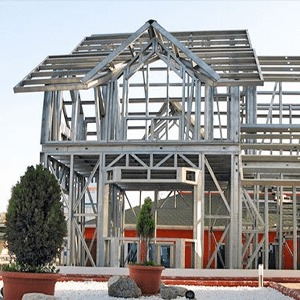
• Steel: Strength and durability for long-term structures
• Sandwich panel: Excellent thermal insulation and instant installation
• Gypsum panels: Smooth and beautiful interior finish
• Three-dimensional (3D) panel: Innovation in construction
• Knauf false ceiling: Flexibility in interior design
• Wood: Natural beauty and good thermal insulation
Concrete wall:
Concrete is one of the heavy and resistant materials that is used to increase the strength of prefabricated structures, concrete walls. Concrete walls are produced in different dimensions and according to the needs and conditions of the customer. Also, these types of walls are mostly used for building prefabricated houses with classic or luxurious designs.
Sandwich panels:
Sandwich panels are one of the materials for prefabricated houses that consists of 3 layers. These panels are produced in different types. Also, the variety of these panels usually depends on the material used in the core. Usually, the middle layer or core is filled with various types of insulation such as polyurethane, rock wool and other such items. The two sides of the core are also covered with various types of materials such as steel, galvanized sheet, etc. As a result, a three-layer structure is formed that has its own advantages and disadvantages.
Gypsum panels:
Gypsum panels are one of the prefabricated materials that are produced based on gypsum and water. Of course, the type of gypsum used in these panels has a finer grain than ordinary gypsum. Although these panels are produced on the basis of gypsum; but their surface can be made of other materials such as wallpaper. Also, the appearance of these panels is in the form of a rectangular cube and is mostly used for wall covering.
Knauf false ceiling:
Knauf is a type of gypsum profile that is manufactured in various dimensions in the factory. This structure was marketed dry and used as such.
3D panels:
3D panels are a type of prefabricated material that is produced in three layers. The middle layer of this panel is polystyrene insulation and its two sides are surrounded by a welded metal mesh. Also, this panel is produced in different thicknesses and dimensions and there is the ability to change the dimensions in the core or the insulation in the middle of the panel. In fact, these panels are used to build walls and ceilings in structures and have a number of advantages and disadvantages.
Prefabricated plaster:
Prefabricated plaster is a type of prefabricated material used to design and decorate the walls and ceilings of a house. These plasters are produced in a factory and are based on gypsum.
How does the type of structure and the type of material used in prefabricated houses affect the price?
In general, the type of structure and the type of materials used in a prefabricated house have a great impact on the final price. Of course, this effect can be examined in several aspects:
• More expensive materials such as stainless steel or high-quality wood increase the overall cost.
• Cheaper materials such as some types of PVC or concrete panels can reduce the cost.
• Higher quality and more durable materials such as steel or concrete may be more expensive; but on the other hand, they reduce maintenance and repair costs in the long run.
• Materials with very high insulation properties, including sandwich panels, may be more expensive, but they save energy.
• Insulated structures
Weak materials will have higher ongoing costs.
• Less durable materials may be cheaper initially, but will increase future costs.
• Materials that can be recycled may be more expensive initially, but will be worth more in the long run.
• Heavier structures, such as concrete, may require a stronger and more expensive foundation.
• Lighter materials, such as LSF wood, require a lighter foundation, which can increase costs.
• Materials that require more expertise, such as some complex steel structures, can reduce foundation costs.
Overall, the choice of structure type and material should be made based on budget, specific project needs, environmental conditions, and long-term goals. In fact, sometimes a large initial investment can lead to significant savings in the long run.
Final Words
In this blog, we introduced the materials used in prefabricated houses. As you can see, choosing the material for a prefabricated house is a very important decision that directly affects the quality, durability, cost, and comfort of life.
In fact, each of the materials introduced, from steel and wood to 3D panels and Knauf false ceilings, has its own advantages and disadvantages. You, dear ones, should choose them based on your individual needs, climatic conditions, budget, and long-term goals.
No account yet?
Create an Account


